Many travelers book what sounds like the perfect lodge, only to arrive and find a step-heavy entrance, narrow doorways or a bathtub-only bathroom that simply doesn’t meet their mobility needs. It’s a frustrating and often costly surprise, and it happens because lodge accessibility features vary enormously from one property to the next. A lodge that calls itself “accessible” might mean anything from a full roll-in shower to a single grab bar by the toilet.
This guide walks you through what actually matters and how to check it before you commit. We’ll look at why lodges differ so much, what to inspect in entryways, parking and grounds, and what to verify inside the room, from bathroom setups to doorway widths and bed heights. We’ll also cover lifts and shared spaces in multi-storey properties, how to confirm accessibility claims when booking, and how to match your needs to the right lodge type and destination, finishing with a practical checklist you can use on your next trip.
Why Lodge Accessibility Features Vary So Much Between Properties
If you have ever booked two lodges that both claimed to be accessible and arrived to find completely different realities, there is a good reason for it. Lodge accessibility is not standardized the way hotel chains often are. Many lodges, especially in the Alps and on safari properties, started life as family homes or hunting cabins, and their architecture reflects that. Split levels, sunken lounges and terraced layouts were designed for views and atmosphere, not for wheelchairs or walkers, which makes genuinely step-free layouts rare in older buildings.
Size and ownership matter too. A small family-run lodge may sincerely want to welcome guests with mobility needs and will retrofit what it can: a portable ramp at the entrance, a grab bar beside the toilet, a ground-floor room. These additions help, but they rarely meet full accessibility standards for doorway widths, bathroom turning space or ramp gradients. The lodge is not being dishonest; it simply does not have the budget or the building structure for a complete conversion, and it may not realize what a wheelchair user actually needs.
Why Labels Mean Different Things in Different Countries
The biggest source of confusion is that accessibility labels are not consistent across borders. There is no single international standard that every lodge follows, so a “wheelchair friendly” claim can mean anything from a single ramp at the front door to a fully adapted room with a roll-in shower and widened doorways. In some countries, an official accessibility rating exists and is regulated; in others, the term is pure marketing language with no verification behind it.
The practical takeaway is to treat every label as a starting point for questions rather than an answer. Ask the lodge to describe, in its own words, what a guest in a wheelchair can and cannot do on the property. Vague replies are information too, and they tell you where to probe further before you commit to a booking.
Entry, Parking and Grounds: What to Check Before You Arrive
The journey from your car to the lodge door is where many accessibility plans fall apart, and it is often the part nobody photographs for the listing. Before you book, ask specifically whether there is a step-free route from the parking area to the main entrance, and if a ramp is involved, how steep it is. A ramp that looks fine in a photo can be too steep for a manual wheelchair user traveling alone, so ask about the gradient or request a picture taken from the side.
Distance matters just as much as steps. Accessible parking should be within 20-50 m of the lodge entrance, which is a reasonable range for most mobility needs. If the designated spot sits farther away, ask whether staff can drop you at the door or help carry equipment the remaining distance.
Grounds deserve the same scrutiny as the entrance itself. Many lodges spread their best features across outdoor spaces, and the surfaces between them can make or break your independence once you arrive.
- Ask whether the path from the entrance to the restaurant, terrace and lounge is paved, decked or gravel, since loose gravel is difficult or impossible for wheelchairs and tiring for walkers and canes.
- Find out whether firepits, viewing areas and garden seating are reached by level ground or by steps, since these evening gathering spots are often built on raised stone or timber platforms.
- Check if there is covered or sheltered access along the outdoor routes, because a paved path still becomes a problem during rain if you cannot keep a wheelchair or walker dry.
- Ask whether a portable ramp is available for one or two isolated steps on the grounds, and whether staff are trained to position it safely when needed.
Inside the Room: Bathrooms, Doorways and Bed Heights
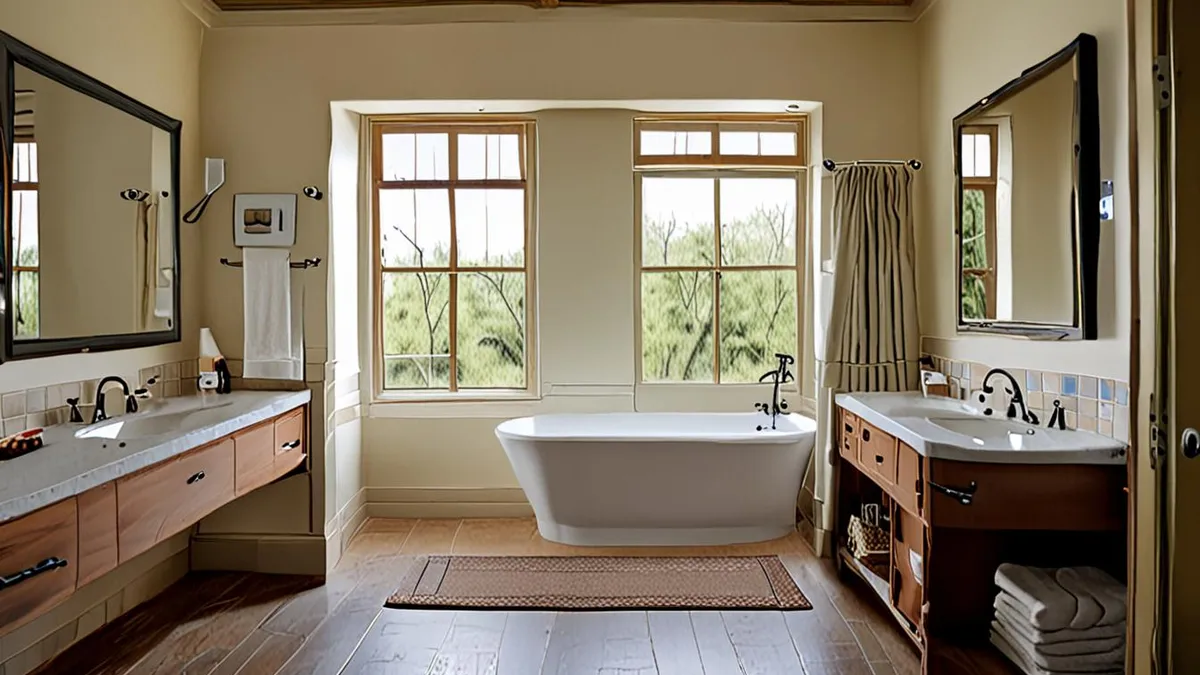
The bathroom is where lodge accessibility claims most often fall short. Many properties list grab bars and call the room accessible, but a grab bar next to a high tub step does nothing for a wheelchair user. A true roll-in shower has a flat or barely raised threshold, a waterproof bench and enough turning space inside. Because roll-in showers are far less common than grab bars, ask specifically for one and get that request confirmed in writing before you pay.
Doorways matter just as much. A beautifully adapted bathroom is useless if the bedroom door is too narrow to get through. For most wheelchairs and walkers, look for doorway widths of at least 80-90 cm, including the bathroom door and any doors between the corridor and your room. Ask the lodge to measure if they are unsure, and watch out for heavy doors without handles or levers.
Bed setup is the detail travelers forget to ask about until check-in. A high bed or a bed pushed against a wall can make independent transfers impossible. Use this list when you question the lodge:
- Ask for the exact bed height in centimeters, measured from the floor to the top of the mattress, so you can compare it with your own transfer needs.
- Request clearance on at least one side of the bed, ideally both, so a wheelchair can pull up parallel for a side transfer.
- Check whether the bed frame is solid or on legs, since some frames can be raised or lowered on request while others are fixed.
- Ask if staff can remove decorative footboards, benches or bed ends that block access, and whether this can be done before you arrive.
- Confirm the bathroom door swings outward or slides, since an inward-swinging door can be blocked by a wheelchair inside a small bathroom.
Lifts, Levels and Shared Spaces in Multi-Storey Lodges
Multi-storey lodges are where accessibility plans often fall apart. Many lodges, especially older ones in mountain and safari regions, were built with split levels and terraces, and a surprising number have no lift at all. That means an “accessible” room can still sit at the top of a staircase, which defeats the purpose entirely. Before you book, confirm in writing whether the accessible room is on the ground floor or served by a lift.
Shared spaces matter just as much as your room
Even with a perfect ground-floor room, you still need to eat, relax and possibly use the spa. Check that the restaurant, lounge and spa are reachable without stairs, or ask whether the lodge offers step-free alternatives such as a separate dining area or room service. A lodge that serves breakfast on a mezzanine reachable only by stairs may not be workable for you, no matter how good the room is.
What staff can do for you
If some shared spaces are on another level, ask directly what staff can assist with. Many small lodges will happily carry luggage to your room, serve meals in the lounge, or bring drinks to your terrace if you ask ahead. The key word is ahead: arrange this when you book, not when you arrive tired after a long transfer. A short email listing what you need gives the lodge time to prepare and gives you something concrete to rely on.
How to Verify Accessibility Claims When Booking
Listing descriptions are written to flatter a property, and accessibility phrases are the vaguest of all. “Wheelchair friendly” can describe anything from a single ramp to a fully adapted room with a roll-in shower. Two lodges in the same region, using the same phrase, can offer completely different levels of access. The only way to book with confidence is to verify every claim yourself, before money changes hands. That takes a few extra emails, but it is far easier than arriving to find the reality does not match the listing.
- Request photos of the specific accessible room. Ask the lodge to send current pictures of the room itself, the bathroom and the main entrance. Photos show doorway widths, shower setup and bed clearance in a way no written description can, and a lodge that hesitates to send them is telling you something.
- Get written email confirmation of every feature you need. List each requirement step-free entry, roll-in shower, ground-floor location, grab bars and ask for a reply confirming each one. Email is more reliable than a phone call alone because it creates a record you can refer to at check-in if anything does not match.
- Read recent guest reviews that mention mobility needs. Reviews from travelers with wheelchairs or walkers reveal the real-world details listings omit: the gravel path to the firepit, the steep ramp, the bathroom door that sticks. Search reviews for terms like “wheelchair” or “accessible” and focus on the most recent ones, since renovations and management changes alter accessibility over time.
One more habit worth adopting: keep all of this documentation in a single thread or folder, so you can forward it to the lodge before arrival and remind staff of what was promised. Small properties change managers and front-desk staff often, and a written record removes any argument about who said what.
Because accessible rooms are typically only 1-2 rooms per lodge, they are the first to go, especially in high season. Once your verification is done, book 2-3 months ahead so the confirmation you worked for is still attached to a room you can actually get. If a lodge cannot confirm your requirements in writing, treat that as your answer and move on to the next option on your list.
Matching Accessibility Needs to Lodge Types and Destinations
Accessibility is not one-size-fits-all, and neither are lodges. The right questions depend heavily on where you are going and what kind of property you are booking, so it pays to match your checklist to the destination before you start emailing lodges.
Alpine lodges in winter
A step-free entrance is only step-free until the snow arrives. In winter, alpine lodges add snow and ice to access routes, which can turn a gentle ramp into a genuine hazard. Ask whether paths and ramps are cleared regularly, whether the entrance is heated or covered, and whether staff can help with luggage on icy mornings. A lodge that answers these questions specifically is usually one that has hosted winter guests with mobility needs before.
Safari lodges and raised decks
Many safari lodges are built on raised decks for views and animal safety, which means boardwalks and steps are standard. If stairs are a problem, ask whether the lodge offers ground-level tented rooms instead, since some properties keep a few at deck level specifically for this reason. For a fuller picture of how these properties work day to day, it helps to read what a first safari lodge stay actually involves before you compare options.
National park lodges vary more than any other category. Newer builds near main entrances are usually more accessible than historic buildings, which were often designed long before modern standards. When choosing between two park lodges, the newer construction near the gate is frequently the safer bet for step-free layouts, adapted bathrooms and parking close to the door.
Wrapping Up Your Accessibility Checklist
Most accessibility disappointments happen because a booking was made on trust rather than confirmation. Keep your checks simple: entry access, bathroom setup, room layout and shared spaces. If those four work for you, the rest of the stay usually falls into place. A step-heavy entrance or a bathtub-only bathroom is exactly the kind of detail that never shows up in a listing description, so asking directly is what prevents the surprise on arrival.
Once you know what you need, confirm everything in writing and book early. Accessible rooms are limited and tend to go first, often months before standard rooms fill. Finally, match the lodge type to your needs, whether that means a ground-floor room in the Alps or deck-level accommodation on safari. If this checklist helped you plan, leave a comment or share the article with someone planning their next lodge stay.